
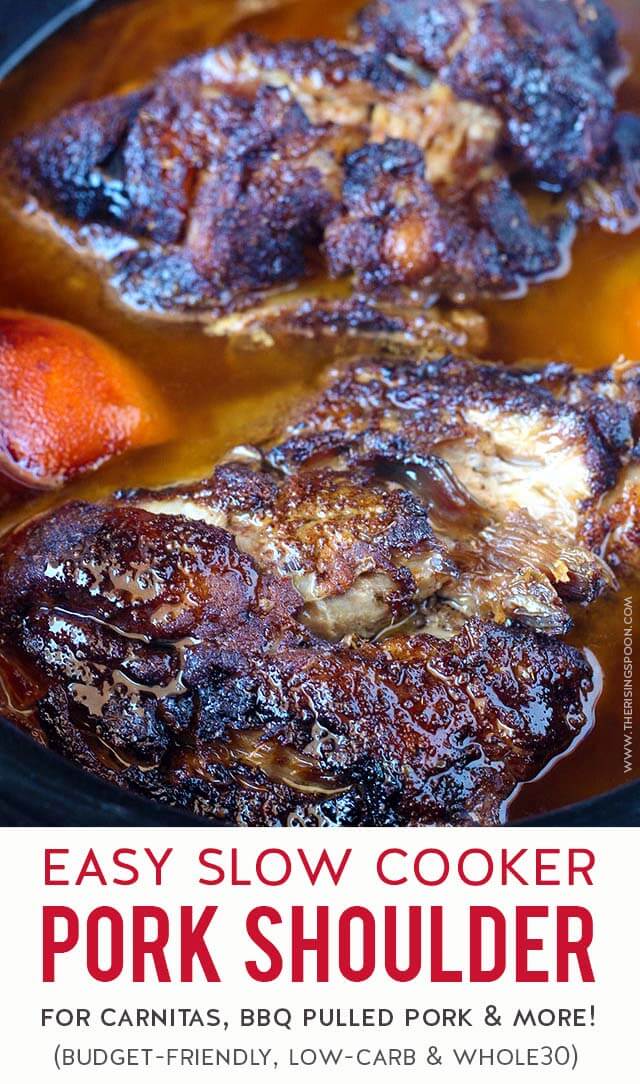
Fall-apart-tender pork shoulder cooked in the crock-pot. This super easy recipe takes less than 10 minutes to prep and can be cooked in as little as 4-5 hours on the high setting. Use the delicious shredded meat for pulled pork and carnitas recipes to make meal planning a breeze, all the while fooling your loved ones into thinking you spent hours over the stove.

Have you ever eaten a pork or beef dish that was so fall-apart-tender it was like cutting into butter? Maybe you ordered it at a restaurant and with each bite of succulent meat imagined the chef painstakingly standing over the cut for two days straight, cooking it low and slow to perfection.
The good news is you can replicate this at home with hardly any effort. The key is the buy a large cut of meat with lots of connective tissue and fat.
This is where the magic happens. When you take a tough cut of meat that's NOT super lean and you cook it beyond well-done, all of the connective tissues break apart and creates the most tender, luscious, shreddable meat.
If you've ever made pot roast or Mississippi pot roast, you know what I'm talking about. Take a simple chuck roast, coat it with spices, slow cook it for several hours and you have amazingly fork-tender beef to serve with your favorite sides like mashed potatoes and gravy or mashed cauliflower "potatoes".
Well, today I'm focusing on pork shoulder, which is the chuck roast of the pork world, except better. This is the cut of pork that magically transforms into crave-worthy pulled pork or carnitas.
You know, extra-napkins-required, barbecue-sauce-dripping pulled pork sliders and juicy-on-the-inside, crispy-on-the-outside street-style carnitas tacos topped with cilantro, onion, and red + green sauce.
The good stuff.

Updated Recipe + Pork Shoulder F.A.Q. (Scroll To The Bottom For The Recipe If You Have No Questions)
I originally shared this pork shoulder recipe & cooking technique on the blog back in 2012, and have decided to re-photograph + update it in a new post today.
Mostly because in the original post I shared two methods for cooking pork shoulder--crock-pot and oven-roasted--and I no longer use the latter technique. There's nothing wrong with using the oven. I just find an inexpensive manual slow cooker way easier and more reliable. It always comes out moist and tender and there's no babysitting required.
I also receive quite a bit of traffic from people asking specific questions about cooking a pork shoulder, so I figured this was a good opportunity to address them here.
If you have any questions, peruse through the following section. If not, scroll down to the recipe.
Frequently Asked Questions (FAQ): Pork Shoulders
1. What is Pork Shoulder and Which Part of the Pig Is Used?
Pork shoulder goes by many names: Boston butt, Boston roast, pork butt, shoulder butt, shoulder roast, country roast, shoulder blade roast, and arm roast (a.k.a. picnic ham - NOT to be confused with actual ham, which comes from the back part of the pig).With so many names, it gets confusing. To keep it easy, think of "pork shoulder" as the broad term that describes the whole front shoulder area of the pig, which is broken up into different cuts (hence the many names). If you want to know more, check out this source, which goes into depth about the many different cuts of pork.
2. Why Is Pork Shoulder The Best Cut For Pulled Pork or Carnitas?
For pulled pork and carnitas, we need juicy, tender, easily shreddable meat, which you won't get using a lean (i.e. almost fat-free) cut of meat like the loin. So, it's important to choose meat that has a generous amount of fat and connective tissue (like collagen) throughout it. Why?- The fat adds flavor and helps to keep the meat moist.
- Cooking the meat for an extended period of time past "well done" (145 degrees) to a higher temperature helps to break down the collagen into gelatin, which adds moisture back into the meat and helps keep the muscle fibers relaxed (so they don't seize up and expel all their juices, thus making them tough & dry). (Source: The Science of Good Cooking)
3. Should I Choose Boneless or Bone-In?
There's no right or wrong answer here. Both will work; however, I always use bone-in because the bone adds extra flavor and I can save it to use for homemade bone broth or ham & beans later on.Cook's Illustrated recently wrote about roast pork in this special collector's edition magazine and decided bone-in pork butt was their favorite cut because the bone has more connective tissue attached to it and also helps to keep the roast cooking at a slower, more even pace.

4. What Size Pork Shoulder Should I Buy?
It depends on how many people you're trying to feed and/or how many leftovers you want. I typically get pork shoulder when it's on sale, so it makes more sense to buy a larger 8 to 9 lb. Boston butt so I have tons of meat for multiple meals throughout the week and then plenty more to freeze for future meals. I'm not joking about the amounts here...you will have a buttload of meat!Oh, and keep in mind that if you have a smaller crockpot, a huge pork shoulder may not fit in there; however, you can easily cut off the parts that won't fit and save that meat for another meal like soup.
5. Do I Need To Add Liquid When Slow Cooking?
As long as you're choosing a cut with plenty of fat and connective tissue, you don't need to add any liquid to keep it moist; the meat will create its own liquid as it cooks down; however, if you want to add some liquid for flavor, that's totally fine. I use a bit of chicken broth and citrus juice in this recipe and there are others on the internet that use beer or soda. (Note: I would caution against using too much liquid (many cups), as that will dilute the delicious pork flavor of the liquid gold that forms.)
6. How Long Does It Take to Cook a Pork Shoulder in a Crock-Pot?
This will depend on the size of the meat, whether you cut it into pieces, and at what temperature/setting you're cooking it. In my experience, a 4 lb. bone-in pork shoulder typically takes 6-8 hours on the low setting and 3-4 hours on the high setting in my manual slow cooker. One that's twice the size (7 to 8 lbs.) will take twice as long (12-14 hours on low and 6-8 hours on high).I've found that cutting the pork shoulder into two pieces helps it cook a little faster and fit better in the crock-pot, so that's what I do. Keep in mind that these times will vary slightly based on the size and temperature of your individual slow cookers (some run hotter than others).
7. At What Temperature is Pork Shoulder Done? When Should I Shred It Into Pulled Pork or Carnitas?
If you own a meat thermometer and want to check it that way, the pork should be easily shreddable when it hits 190 degrees. As I mentioned above, you're cooking it way past "well done" in order to break down all the connective tissue, which turns into gelatin and makes the meat fall-apart-tender.But, you don't need a meat thermometer to know when it's ready. (I never use one.) All you have to do is open the slow cooker and stick it with a fork. When the meat breaks apart with minimal effort, it's ready for shredding.

8. Why Isn't My Pork Shoulder Shredding?
If it's not shredding, then you either:1) didn't cook it long enough or to a high enough temperature (make sure it's at least 190 degrees)
OR
2) bought a lean cut on accident that was not meant for longer cooking (like pork tenderloin)
9. What's The Difference Between Pulled Pork and Carnitas?
Full Disclosure: I'm not an expert by any stretch of the imagination in barbecue (i.e. smoked meats) or Mexican cuisine. I'm just a self-taught home cook who likes to experiment with food and learn as I go in my real food journey. With that in mind, I'm going to attempt to distinguish the two as I understand them. If you have more knowledge of these dishes or would like to correct me, please share your wisdom in a comment below.
Pulled pork is meat from a pig (typically from the shoulder region) that has been slow-cooked until it's easy enough to shred, whereas carnitas (meaning "little meats") is a version of pulled pork that's often fixed with Mexican spices (or simply salt). Although both yield the same basic results--tender shredded pork--both of the traditional cooking methods and final prepared dishes are unique.
Note: Countries all over the world have their own version of pulled pork, but for all intents and purposes, I'm referring to the American version of pulled pork today (since my audience is primarily in the United States).
Pulled Pork
In different regions of the U.S., pulled pork is traditionally prepared by smoking a pork shoulder over low heat, shredding it, and then mixing the meat with a barbecue sauce (or not - some folks just use a dry rub). A popular way to serve it is on a big soft bun with sliced pickles. Another super delicious way is to sauce it with a vinegar-based North Carolina-style barbecue sauce, pile it on a bun, and then top it with creamy coleslaw. These days I like to make pulled pork sliders with a sweet & smoky Kansas City-style BBQ sauce & vinegar slaw.
Carnitas
In contrast, carnitas are traditionally prepared by braising the pork (cut into chunks) in a pot over the stove with plenty of lard. Once you're further into the cooking process, you crank up the heat in order to get some crispy char on the edges of the pork. You can then serve the juicy, crispy bits of meat in a variety of Mexican-inspired recipes like tacos, burrito bowls, and enchiladas. Or as a main course with 7 layer bean dip + some cilantro lime rice on the side.
Seeing as most home cooks don't have a smoker or a huge bucket of lard on hand, slow cooking is the next best option for those of us who want to enjoy pulled pork or carnitas at home. Will this satisfy a barbecue or carnitas purist? Maybe, maybe not. Either way, it's still good food.

10. How Should I Reheat Leftover Pork Shoulder?
If I haven't mixed the pork into a dish yet, my favorite way to reheat it is on the stovetop. I typically mix the cooking liquid back into the shredded meat before storing it, so I just grab a chunk of it from the container, plop it into a skillet, and warm it back up until the edges start to get a bit crispy, while still retaining moisture.
When I store the cooking liquid separately from the meat, I'll add a heaping spoonful to the skillet along with the pork. Is it good without the cooking liquid? It's okay. The liquid has a TON of flavor from the pork fat/gelatin + the spices and citrus juice, so I always add at least some of it, even if I'm using the shredded pork in a barbecue recipe.
Watch The Recipe Video
Before you jump into the instructions, make sure to watch my short recipe video by clicking below. It illustrates the super easy process of making a pork shoulder in the slow cooker!
Yield: 4 1/2 cups of Shredded Pork (approx.)

Slow Cooker Pork Shoulder (For Carnitas & Pulled Pork)
prep time: 10 Mcook time: 8 hourtotal time: 8 H & 10 M
Fall-apart-tender pork shoulder cooked in the crock-pot. This super easy recipe takes less than 10minutes to prep and can be cooked in as little as 4-5 hours on the high setting. Use the delicious shredded meat for pulled pork and carnitas recipes to make meal planning a breeze, all the while fooling your loved ones into thinking you spent hours over the stove.
ingredients:
For The Pork Shoulder:
- 4-5 lb bone-in skinless pork shoulder* (like Boston butt, pork butt, or shoulder roast)
- 3 1/2 tablespoons of spice rub (see recipe below)
- 8 cloves of garlic, peeled & crushed
- 1 onion, peeled and chopped
- 1/2 cup of low-sodium chicken broth
- 1 large orange
- 1 lime, juice only
For The Spice Rub:
(add one heaping teaspoon of each of the following dried spices)
- ground cumin
- garlic powder
- onion powder
- chili powder
- cayenne pepper
- oregano
- white pepper
- black pepper
- sea salt (like THIS salt or THIS salt)
- cinnamon powder (I love this Ceylon cinnamon powder - it tastes way better!)
- organic raw sugar or coconut sugar (optional - omit for whole30 or low carb)
instructions:
How to cook Slow Cooker Pork Shoulder (For Carnitas & Pulled Pork)
- Pat the pork shoulder dry and cut it into two pieces, making sure to avoid the bone. Combine the spice rub ingredients and rub all over the pork, getting in every nook and cranny. Put both pieces of the pork shoulder in the slow cooker with the fat cap facing up. Place the onion and garlic around the pork and pour in the chicken broth. Quarter the orange and lime and squeeze both of their juices into the cooker. Stick the spent orange wedges in with the onion & garlic, but discard the lime.
- Cook the pork either on low for 8 hours OR on high for 5-6 hours OR until the meat is fall-apart tender. The cook time will vary based on the weight of your pork and the size/temperature of your slow cooker, so it's best to check it after about six hours on low and 4 hours on high just to see how it's doing. You'll know it's done when you stick a fork into the meat and it takes barely any effort to fall apart; however, you can also use a meat thermometer to see that it's reached a minimum of 190 degrees internally.
- Remove the pork from the slow cooker and let it cool for a few minutes, then shred the meat with two forks, making sure to pick out and discard any chunks of fat that remain (like the fat cap). At this point, you'll have a lot of meat and several cups of cooking liquid (approximately 4 1/2 cups of shredded meat & 2 cups of liquid for a 4 lb roast). Don't throw away the liquid! It's full of flavor + yummy fat and helps to keep the meat moist. (See notes below for what to do with it).
- Store extra pork in the fridge (it'll give you meals for the next week) and consume within 5-6 days, otherwise, mix the leftovers with the rest of the cooking liquid and freeze in an airtight container (I use ziplock bags smooshed flat to take up less space).
NOTES:
DOUBLING THE RECIPE: When I fix a larger 7-8 lb pork shoulder, I use the same amount of onion, garlic & broth, but double the spice rub, orange, and lime.
WHAT TO DO WITH THE LIQUID: If you want to use the meat for both carnitas and pulled pork style dishes, keep the liquid and meat separate since it's flavored with Mexican-style spices. If you're just using it for Mexican or Tex-Mex-style recipes, go ahead and mix the liquid in now.
CARNITAS RECIPES: When you're ready to use the meat carnitas-style for tacos, enchiladas, burrito bowls, etc., mix the meat with a bit of the liquid (it will become gelatinous as it cools in the fridge) and heat in a skillet until the edges become crispy, but the insides are still moist,
PULLED PORK RECIPES: If you want to use the meat for pulled pork, add a smidgen of the cooking liquid to help keep it moist when you reheat, then toss the meat with your favorite barbecue sauce or seasonings.
© The Rising Spoon. All images & content are copyright protected. Please do not reprint this recipe without my written permission. If you'd like to feature this recipe on your site, please take your own pictures, rewrite the directions in your own words, and link to this post as the original source. Thank you!
Did You Make This Recipe?
I'd love to hear your thoughts on how it went! Please leave a comment here on the blog, on Pinterest via the "tried it" feature, or use the hashtag #therisingspoon & tag @therisingspoon when you share pics to Instagram, Facebook, or Twitter. It helps me to get feedback on my creations and it totally makes my day. :)
I'd love to hear your thoughts on how it went! Please leave a comment here on the blog, on Pinterest via the "tried it" feature, or use the hashtag #therisingspoon & tag @therisingspoon when you share pics to Instagram, Facebook, or Twitter. It helps me to get feedback on my creations and it totally makes my day. :)
Click Here to Save This To Your Slow Cooker Recipes Board on Pinterest!
PAID ENDORSEMENT DISCLOSURE: In order for me to support my blogging activities, I may receive monetary compensation or other types of remuneration for my endorsement, recommendation, testimonial and/or link to any products or services from this blog. However, I ONLY recommend helpful products that I myself would use. And I'm really picky about what I share with you guys. Because I myself am super choosy about what I buy and consume. Recommending products that I love or want to own helps me cover the costs of running this blog and keep providing you with free, helpful information. And it costs nothing extra for you. Thanks!
MEDICAL DISCLOSURE: The information included on this website is intended for educational purposes only. It is not intended nor implied to be a substitute for professional medical advice. None of the opinions expressed here are meant to diagnose or treat any disease or illness. You should always consult your healthcare provider to determine the appropriateness of the information for your own situation or if you have any questions regarding a medical condition or treatment plan.
No comments
Post a Comment
Note: Only a member of this blog may post a comment.